

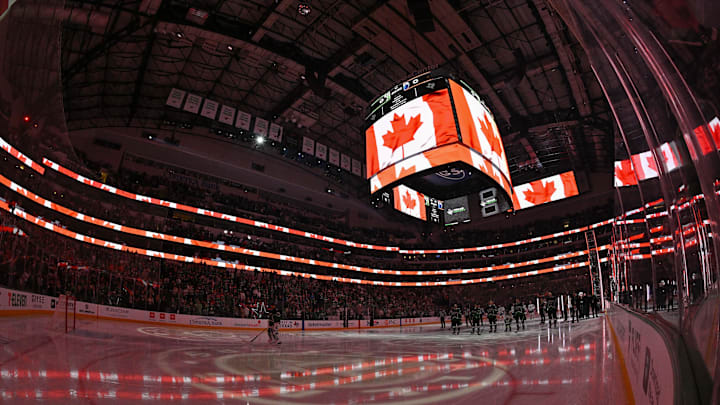
When legendary goal scorer Maurice Richard died in 2000, Montreal mourned deeply. And with good reason. The city had lost much more than a hockey player. They lost one of them. Thousands of fans lined the streets for his funeral procession, applauding “The Rocket” as he took one final lap on the figurative ice. And more than 115,000 people paid their respects while Richard lay in state, a public response that offered insight into his connection with Canadiens history and Quebec culture.
Richard’s link to Montreal extended beyond his eight Stanley Cups and five scoring titles. For generations of French Canadians, he symbolized pride and success during a time when Quebec was undergoing significant cultural change. The victims of discrimination by the English-speaking population, French Canadians looked up to Richard for putting them in the spotlight. In an era where they sought equality, he appealed to their aspirations by putting skills on display that exceeded others’. Long before athletes became global celebrities, Richard had ascended to represent the identity of a people. If the Canadiens franchise was a religion, Richard was its mythical figurehead.
That emotional bond was immortalized one final time during the closing ceremony of the Montreal Forum in 1996. After the Canadiens played their final game in the legendary arena, former team captains were introduced to the crowd. When Maurice Richard stepped onto the ice carrying the ceremonial torch, a frenzied fan base—including current players—roared with applause. The standing ovation lasted so long that the ceremony repeatedly stalled as fans refused to stop cheering. Richard, normally reserved in public, appeared visibly emotional as the crowd showered him with appreciation. More than a tribute to a Hall of Fame career, Montreal used the opportunity to give a final thanks to a player who scored for them on and off the ice.
For vintage hockey collectors, perhaps no card better captures that incomparable history than the 1951 Parkhurst Maurice Richard rookie card.
The 1951 Parkhurst set remains one of the defining hockey releases of the postwar era. Unlike many modern designs overloaded with foil and gimmicks, Parkhurst relied on simplicity: indelible color backgrounds, clean typography, and stellar portrait photography. The result is a set that captivates the imagination of collectors of all stripes. The checklist also features some of hockey’s most legendary names, including Gordie Howe and Terry Sawchuk.
Richard’s card garners attention for several reasons.
First, the card holds significant historical meaning. Richard was more than just one of the best to lace up skates; he was a transformational figure who lifted a city’s spirits during challenging times. He made people believe in themselves and feel pride. In the process, Richard became the NHL’s first player to score 50 goals in 50 games and later the league’s first 500-goal scorer, accomplishments that further elevated his stature.
Second, the card’s low pop count has increased demand. For those that survived shoeboxes in attics and family members who went on throwing out binges, early 1950s Parkhurst cards are notoriously condition-sensitive because of weak paper stock, rough cuts, centering issues, and print defects. PSA’s population data shows only a limited number of high-grade examples remain, with only 5 graded Mint 9 and none reaching Gem Mint 10.
Finally, there is the card’s visual appeal. The card has character. If it could speak, it would not need to say anything. It is everything collectors imagine a vintage card should be: simple, elegant, colorful, and understated in a way that represents the “Original Six” era. Even well-worn copies appeal to collectors as they carry an authenticity from hockey’s early days.
The best vintage cards tell stories that extend beyond statistics. The 1951 Parkhurst Maurice Richard succeeds because it represents more than goals, individual awards, or titles. It captures the legacy of a player who became inseparable from the identity of an entire city. Seventy five years after its release, the card still carries the emotional gravity of that unforgettable night at the Montreal Forum, when an arena full of fans stood and applauded until one of hockey’s greatest legends nearly broke down. The player is gone, but the legend lives on through a card that now belongs to the ages.
 Add us as a preferred source on Google