

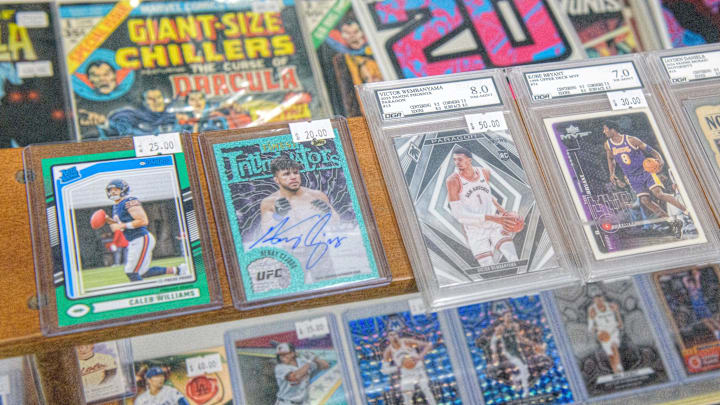
Sports card collecting has probably never been more popular than it is right now. Prices are extremely strong almost across the board, as more and more people start entering the hobby and increasing demand despite print runs going higher and higher. However, this modern expansion of the hobby has also highlighted that there is a barrier of entry for new collectors when it comes to knowledge and verbiage.
Collecting anything leads to the creation of shorthand terms used among hobbyists. Some terms are very basic and often self-explanatory, while others are more esoteric and require a bit of insider knowledge to decipher. Thankfully, we are here to help.
Introducing the Grading on the Curve Card Collecting Glossary
The goal here is for this to be a living document that is updated as appropriate. As a result, there is a very good chance there will be terms you hear that won’t be listed here just yet. Just know that this list is going to be constantly re-evaluated and changed over time as we want it to be a true living document. Here’s the list of collecting terms we identified as ones collectors need to know.
Auto (Autograph)
A card that features an authenticated signature from an athlete, either signed directly on the card or via a sticker placed on the card. Multiple players’ autographs can appear on the same card.
Back Damage
Wear, scratches, or printing defects on the reverse side of a card that affect the condition, including the surface and edges. Generally less of a knock against a card in terms of grading than damage to the front of the card.
Base Card
Standard, non-insert card that makes up the main checklist of a product. Often has parallels, but true base cards are not parallels themselves. The most basic card you can get, essentially.
Blaster Box
A retail format product with fewer packs than hobby boxes and generally lower odds of premium hits, but allows for an entry-level buy-in option for collectors.
Booklet Card
A thick, fold-out card that opens like a book and may include multiple autographs, relics, or players. Almost always a premium hit in any given product.
Break (Card Break)
A group purchase where boxes or cases are opened live, and cards are distributed by team, player, or other type of slot. Sometimes you can buy a specific spot for a specific price, other times it is randomized with all spots costing the same amount, so make sure you know the rules before buying any spots.
Buyback
A previously released card that is repurchased by the manufacturer and reinserted into packs, often stamped or autographed.
Case
A sealed box of boxes from the same product. Sometimes they areopened together, especially in breaks. Others get broken up, and each box is sold/opened individually.
Case Hit
A rare insert or card that usually appears once per case, including some variations. Are often not numbered, but are generally considered super short-prints.
Centering
The alignment of the card image relative to the borders; a major grading factor. Much more difficult to determine with cards that do not have borders.
Checklist
The complete list of cards included in a product or set. Often include all of the parallels as well.
Chrome
A shiny, chromium-style card stock known for durability and refractor parallels. Holds a premium in the market over “paper” versions of the same card.
Color Match
A parallel whose color matches the player’s team colors. Sometimes debatably accurate depending on the team and colors in question.
Comps (Comparables)
Recent sales data of similar cards is used to determine market value. Such figures can come from eBay sold listings and/or third-party sales tracking apps.
Corner Ding
Damage or wear to a card’s corner that negatively impacts grade and value. “Corner wear” appears to be more gradual whitening, while a “ding” is more distinct and the result of the corner being hit at some point in its life.
Cracked Slab
A graded card that has been removed from its original slab. Common practice for cards with subpar grades so that they can be sold at the price of an ungraded version, aka “a raw card”.
Die-Cut
A card cut into a custom shape rather than a standard rectangle. Sometimes very basic, while others are more intricate. Die-cuts are extremely hard to get good grades for because of the increased number of corners/edges.
eBay 1/1
A misleading term implying rarity for a card that is not actually a one-of-one serial-numbered card. Often used when a card is numbered with a player’s uniform number or is the last card in a print run. Generally seen as a derogatory or sarcastic term.
Edge wear
Used to describe the condition of cards where whitening and wear are visible on the edge(s) of the card. Dramatically decreases the likelihood of grading highly if present.
Embossed
A card with raised texture or lettering pressed into the surface.
Factory Set
A complete card set packaged and sold directly by the manufacturer. Generally only done with select flagship products.
Foil
A metallic or reflective finish applied to parts of a card. Textures and exact looks often vary from product to product and can include some parallels depending on the product.
Gem Mint
A near-perfect condition card, usually equivalent to a PSA 10 or capable of getting that grade if describing a raw card.
Glossy
A smooth, shiny card finish prone to showing surface scratches.
Grading
The professional evaluation of a card’s authenticity and condition by a third-party company. Not all grading companies are created equal, with PSA largely considered to be the gold standard. SGC is a solid, more budget-friendly option, along with CGC.
Hit
A desirable pull such as an autograph, relic, or low-numbered card. Can also include certain types of short prints that aren’t guaranteed in a box.
Hobby Box
A box sold through hobby shops with better odds and exclusive hits compared to Retail. Often includes some number of guaranteed hit(s). Can be used to describe all hobby formats with guaranteed hits or as distinct from other formats like Breaker’s Delight or Jumbo.
Image Variation
A short-printed version of a card featuring a different photo than the base version. Often has the same set number, but is noted as being a variation on the back of the card in some form or fashion.
Insert
A non-base card with a unique theme, design, or rarity. Range from very common to exceedingly rare, so it is important to know product odds for each one to discern which is which and how rare/valuable they are.
Jersey (Relic) Card
A card containing a piece of game-used or player-worn memorabilia. Can be referred to as a “mem” or “mems”, but “relic” is more common these days.
Junk Wax Era
The late 1980s to mid-1990s period of massive overproduction in the card industry. Can still be bought very cheaply even today, though there are some cards (particularly certain rookies) that can have real value, especially in high grades.
Letter Patch
A relic card featuring a large letter from a jersey nameplate. Tend to be extremely low-numbered, with 1/1s being most likely.
Loader (Top Loader)
A rigid plastic holder used to protect sleeved cards. Incredibly important to protect cards from damage, and they come in a slew of different sizes and form factors.
Logoman
A premium relic card featuring the NBA/MLB/NFL/league logo from a player’s jersey. Very often found as a 1/1 card when they do appear. Among the most desirable cards in the hobby.
Lot
A group of cards sold together in a single listing. Often grouped by team/player/product.
Mag (One-Touch)
A magnetic hard case used for displaying and protecting high-end cards. Not to be used for travel, as cards can rattle around in them and become damaged.
Master Set
A complete set including base cards, inserts, and often parallels, as well as variations. A quest for the true card sickos out there.
Memorabilia Card
A card containing a piece of player-used material. Sometimes shortened to “mem” it is a more general relic category that includes jerseys, bat pieces, and other gear.
Misprint
A card with a factory printing error. Some (but not all) can be quite valuable, such as the Frank Thomas No Name On Front (NNOF) rookie. Can range from very common to exceedingly rare, depending on the misprint and the product it was in.
Numbered (Serial-Numbered)
A card stamped with its print run (e.g., 12/25). Will almost always be short-printed to some degree, ranging from thousands in a print run to a true 1/1.
On-Card Auto
An autograph signed directly onto the card surface. Tend to be favored over sticker autos by collectors.
One-of-One
A card of which there is only one in existence. Will be designated with a “1/1”, “One of One”, or similar marking on the card itself.
Parallel
A variation of a base card with a different color, finish, or serial numbering. Usually has a distinctive visual cue; some can be weirdly subtle and difficult to identify (flip stocks from Topps Heritage being one example).
Patch
A premium relic card featuring multi-color or textured jersey pieces. Much more desirable than “napkin relics,” which are generally one color with few distinguishing features.
Penny Sleeve
A thin plastic sleeve used as the first layer of card protection. Often used in conjunction with traditional top loaders for maximum protection.
POP (Population)
The number of copies of a card graded at each grade level by a grading
Company. The lower the population at a given grade (as long as the grade is good), the higher the premium a card can command. PSA’s POP Report is most often what is being referenced.
Print Line
A visible factory defect line often found on chrome cards. Can be difficult to see unless at certain angles or blatantly obvious. Essentially makes a card not worth grading.
Print Run
The total number of copies produced of a specific card. Sometimes this is a known specific number released by the brand producing the card and possibly marked on the card itself; other times, it is an approximation based on known odds.
Prospecting
Collecting young or unproven players in hopes of future value increase. Happens most often in Bowman products that have Bowman 1st cards in them.
PSA 10
Gem Mint condition as defined by the premium grading company Professional Sports Authenticator (PSA).
Raw
A card that has not been professionally graded and/or is not in a sealed slab.
Redemption
A card with a code that must be redeemed with the manufacturer to receive the actual card later. Often used when a player has agreed to sign cards for a given product, but was unable to do so before the product was packed. Can be a quick process or take many months.
Refractor
A chrome parallel with a rainbow or light-reflective finish. Long has been a collector's favorite, especially in good condition, due to its look and shorter print runs. More modern cards have different colored parallel versions of refractors as well.
Retail Box
A box sold through big-box stores that has different (and often far worse) odds than hobby products.
Rookie Card (RC)
A player’s first officially designated rookie card. Will be noted on the card(s) that it is a rookie card with some version of an RC stamp or rookie designation.
Short Print (SP)
A card printed in smaller quantities than standard base cards. Super short print (SSP) is reserved for cards with exceptionally low print runs.
Slab
The sealed plastic holder that encapsulates a graded card. Getting a card “slabbed” simply means getting a company to put a card in a sealed plastic case through authentication and/or the grading process.
Sticker Auto
An autograph signed on a sticker and applied to the card after the fact by the producer. Generally less desirable than on-card autos, but still widely accepted and collected.
Surface
The front and back condition of a card, including scuffs, spots, scratches, or dents.
Superfractor
A highly sought-after 1/1 gold-style refractor parallel. Particularly associated with 1/1 versions of chrome cards in many Topps products.
Super Short Print (SSP)
An extremely rare card with very limited production. No exact number qualifies something to be considered a SSP, but generally is 100 or less, depending on who you ask. If you see abbreviations with more S’s, it is just adding extra of the word “super” for effect.
True Rookie
The earliest officially licensed rookie card of a player. With modern baseball players, it is becoming more and more accepted that a given player’s Bowman 1st card is their “true rookie”, although there are others, especially in different sports.
Variation
A card differing from the base version via image, text, or design. Very often, short-printed to some degree. Almost always listed separately on a product’s checklist with different odds.
 Add us as a preferred source on Google